

Creating Space for Difficult Conversations

Bob Keyes
Ashley L. Conti and Dave Dostie
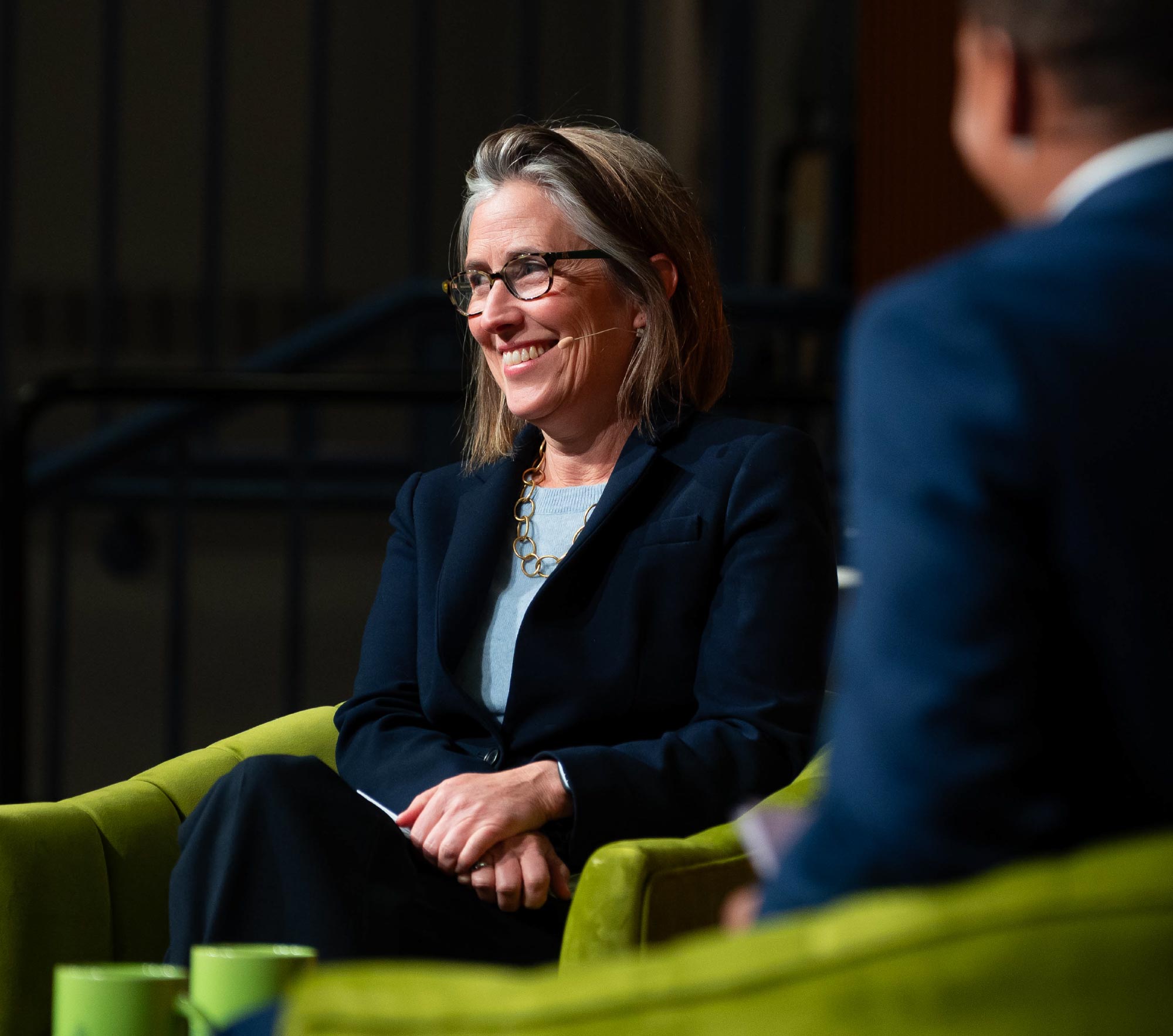
sked to reflect on her experience as a guest of the Goldfarb Center for Public Affairs’ weekly In the News speaker series, Kristen Soltis Anderson described the event as informative and engaging, and then she paused. “And, quite honestly, civil.”
In this time of discord and disagreement, a cordial discussion about politics and current events is noteworthy, and it made an impression on Anderson, a Republican pollster and commentator, who came to Colby during the fall semester to explore the question, “Can Conservatives Win Gen Z?”
The answer to that question is open to discussion in the aftermath of Anderson’s appearance. But most important is that the conversation is happening at all.
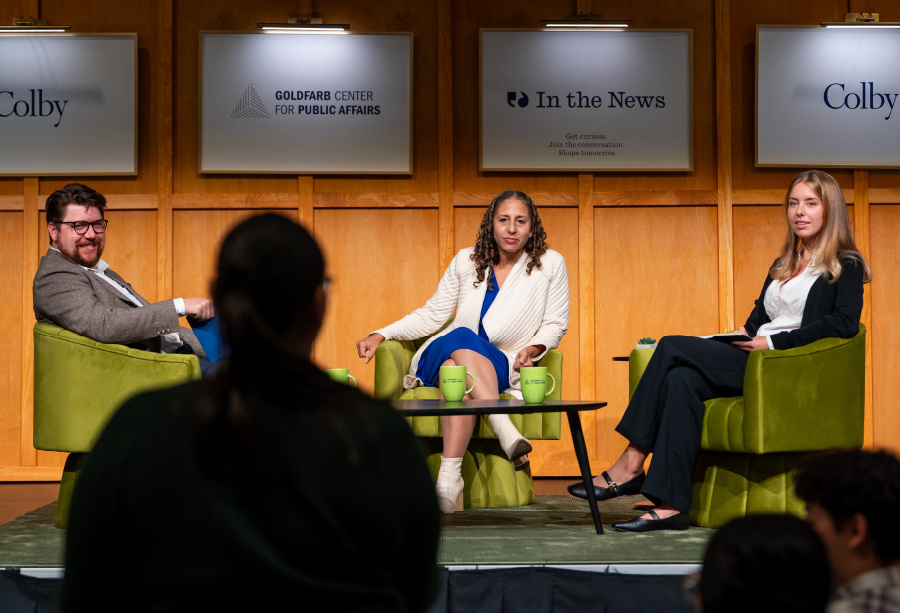
Launched in 2024 by Alison Beyea, senior distinguished lecturer of public policy and executive director of the Goldfarb Center for Public Affairs, In the News has become a weekly standing campus commitment. Every Wednesday from 6 to 7 p.m. during the fall and spring semesters, students gather in the Page Commons Room to share dinner and conversation with leading practitioners and thought leaders. The talks, which have a TV-talk-show quality to them, are open to all students and usually to the public.
The speakers represent a spectrum of opinions, perspectives, and experiences. The series has attracted numerous current and former elected officials at all levels of government, policymakers, pundits, and journalists. Many, including Anderson, are regular contributors on TV news shows, the nation’s most influential opinion pages, and a range of media outlets, including websites and podcasts.
The series has been notable for its balance and as a setting where guests, whose opinions may differ from the prevailing opinions of the students who invited them, can engage in open, spirited, and respectful conversations that are designed not to change opinions, but to provide context and deeper understanding around complex and layered issues that are in the news.
Few Topics Are Off Limits
Dave Boku ’26, a computer science major and mathematics minor, attends nearly every discussion. “I show up because I am curious about the world, and college is a time to get a better understanding of the world and the times we live in,” he said. “In the News gives us an hour to pick someone’s brain on a particular topic, and the conversations that are enabled in that hour are just the beginning. They continue long after the speaker has left campus.”

A Forum for Public Good
In addition to attending the weekly event, students who are enrolled in a related course participate in small-group discussions to talk through a topic, workshop potential questions for the speaker, and review strategies for asking thoughtful questions and speaking in public.
“Time after time, students are asking to hear from people and perspectives they do not necessarily agree with,” Beyea said. “They are hungry to hear about topics and issues that are not comfortable, and it is uncomfortable at times. But it’s a key opportunity that has been missing for some time—people listening to a speaker who may not share their views.”
Students co-host the onstage Q&A with a faculty member. When it’s time for audience questions, only students are permitted to do the asking.

Similar to Anderson, In the News guest Dexter Thomas left Colby with the impression that something different and unique was happening on campus. A multimedia journalist who drew the attention of Beyea for his coverage of TikTok, Thomas was the first guest in the series—for a talk titled “Facebook Fried Your Parents’ Brains. Are You Next?”
He has returned for a second In the News appearance and for other activities. Thomas hopes the model for conversation perfected by the Goldfarb Center is replicated far and wide. “It is too good to be kept a secret,” he said. “Other colleges and universities need to start copying Colby. This program is getting Colby back to what the original possibilities of a learning institution could be, which is bringing people in from the outside to allow students to make things better in their immediate community and the larger society beyond.”

The Student Perspective
Schiffman, a government major and economics minor, also served as an onstage host with Justin J. Pearson, a member of the Tennessee General Assembly and Bowdoin College graduate, who discussed state policymaking, community organizing, and the national political landscape.
The series, Schiffman said, has been widely popular among students. “Across the board, the reaction is positive, because everyone appreciates the diverse viewpoints. Everyone appreciates the diverse subject areas,” he said, adding that “it was incredibly impactful to me to know I was able to make a contribution to people’s education by helping to bring in a diverse voice.”
Government major Uma Graz ’28 began attending the talks soon after the series began in fall 2024. She would vote in her first election that November, and she saw In the News as a way to become an informed voter.
“In the News helped start a lot of conversations,” she said. “I liked going to the events with my friends. We would talk and debate afterwards.”
Last year, she co-hosted a conversation with journalist and author Monica Guzman, who spoke on the topic “Why You Should Talk Politics with Someone Who Thinks You’re Wrong About Everything.”
Graz has taken Guzman’s advice to heart and has begun talking politics with her peers—not to change opinions, but to reach a point of better understanding. “It has helped get us out of our echo chambers. People tend to find common ground with each other when they are able to talk about it,” Graz said.
‘I Think the World of Those Folks.’
With questions swirling about the ethics of AI and the tech industry operating during a time of shifting regulations and surging growth, Doore thought it would be helpful to invite an expert to share information and opinions.
“The country has lost its ability to have constructive conversations. In the News is opening up a forum to teach and model how to have important, difficult, and sometimes controversial conversations in a way that supports our democratic process and our campus community,” Doore said. “I think the world of those folks over there, and I feel lucky to be involved.”
Nicholas Jacobs, the Goldfarb Family Distinguished Chair in American Government and the inaugural director of Colby’s Bram Public Policy Lab, described In the News as an effort to satisfy a basic principle of American civic life.
We believe that democracy is about living in disagreement with people,” Jacobs said. “We think that practicing how to live in disagreement with people in the environment of In the News is a step forward in creating a healthy civic culture, not just for that one hour that we’re together, but across the campus and then throughout their lives, wherever our graduates go.”