

Ethical AI

Bob Keyes
Brian Fitzgerald
Skeptics wondered if Colby was overreacting.
“There were two questions that came up constantly.” recalled President David A. Greene. “The first was, ‘Why are you doing this?’ which no one would ask now. And the second was, ‘Why be so ambitious about it?’ And on that one, I would say that what we did has been fantastic and we also undershot the moment given how much AI is there now. We need to keep doing more.”
As the first-of-its-kind facility at a liberal arts college, the Davis Institute for Artificial Intelligence is meeting the AI moment by turning the technology from a source of apprehension into an academic asset and a tool with the potential of more benefit than harm. Under the leadership of Director David Watts, the Davis Institute is pioneering an interdisciplinary approach that empowers faculty and students to leverage machine learning into diverse fields.
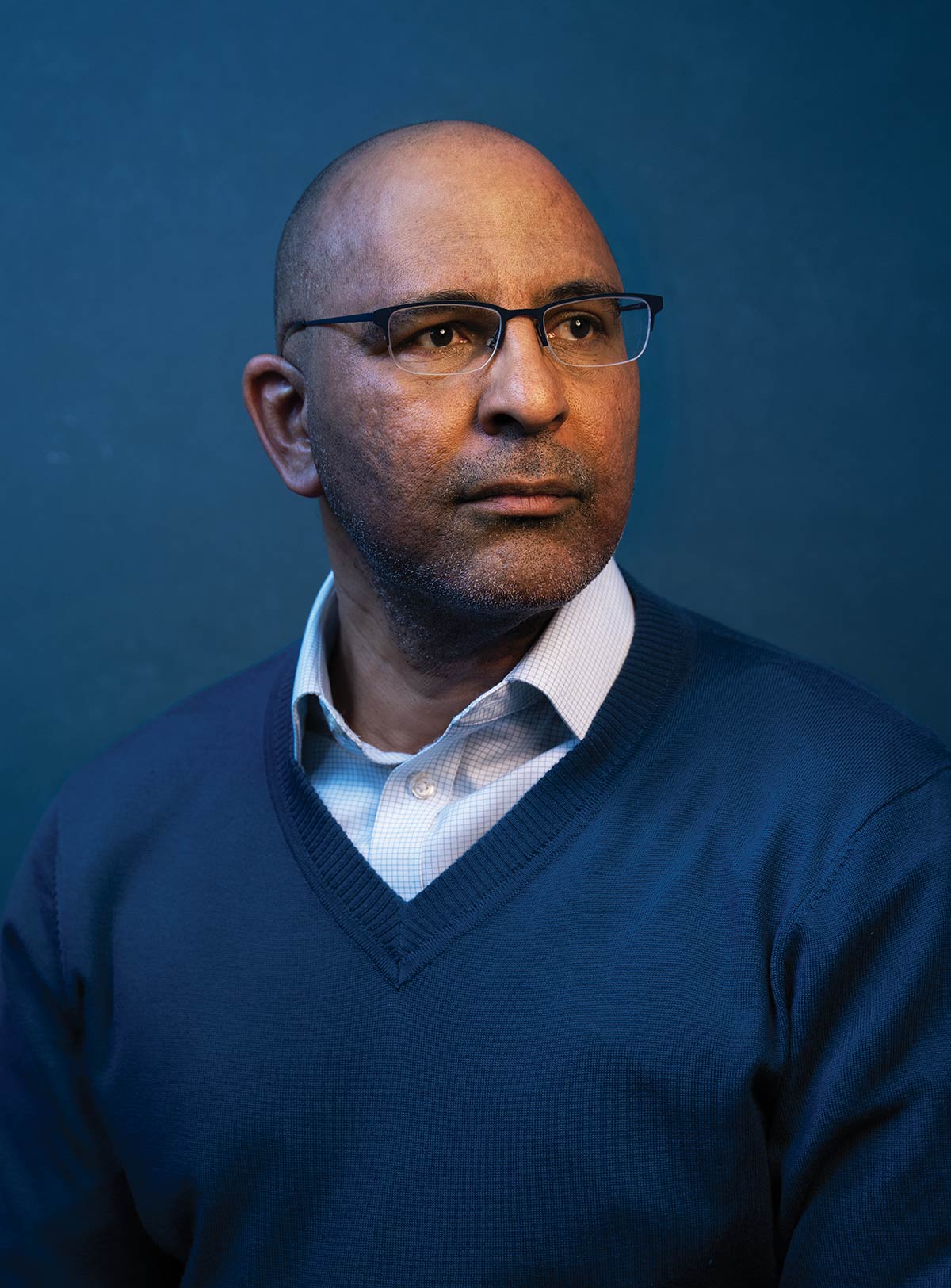
“We are building things for the betterment of humanity, and we believe that a liberal arts college is one of the best places to do that, because the challenges of AI require an interdisciplinary approach,” said Watts, who came to Colby in 2025 after a 30-year career across the tech sector, with expertise in integrating AI into enterprise-scale products and services as a vice president at IBM. “It requires people who are willing to go into new spaces, and it’s not just about your space.”
Since Davis AI was established, the use of artificial intelligence has shifted from niche applications to widespread multimodal systems involving reasoning and content creation. The technology is routine in daily life—in ways obvious and subtle—and has been integrated into applications across industries.
At Colby, Davis AI has evolved with its core mission remaining focused on leading human-centered AI innovation in the liberal arts through collaborative, interdisciplinary creation and responsible, ethical application.
An accomplishment that validates its early work in the AI realm, Colby was the only liberal arts college among a select group to participate in a $100-million investment by the National Science Foundation in support of newly created National Artificial Intelligence Research Institutes. Colby will work in collaboration with Dartmouth College, Brown University, the University of California, Berkeley, and others to drive breakthroughs in high-impact areas such as materials discovery, STEM education, mental health, human-AI collaboration, and drug development.
Formally named the AI Research Institute on Interaction for AI Assistants (ARIA), the Colby cohort will accelerate the development of next-generation AI chatbots that understand context and can respond in socially and emotionally smart ways, particularly related to mental health.
Principal investigators for Colby are Assistant Professor of Psychology and recent Davis AI Fellow Veronica Romero ’09 and Assistant Professor of Computer Science Isaac Lage, who specializes in human-AI interactions.
Empowering faculty
A primary vehicle for this engagement is the Faculty Instructional Technology (FIT) Fellowship, a one-semester program that encourages faculty and staff instructors to explore AI mechanics, grapple with ethical dilemmas, and revise course materials with a hands-on, collaborative focus.
Significantly, the Davis AI FIT fellows have represented all the major buckets of academic disciplines at Colby. This spring, fellows were Alex Casey from Human Resources, the first time bringing in a staff member with a primarily non-instructional role; Alyssa Lawson, visiting assistant professor of psychology; Nicholas Silcox, assistant professor of English and environmental humanities; and Debra Spark, Zacamy Professor of English.
“It’s been really special to work with faculty members, especially in the humanities and social sciences, places you might think have no interest in AI or in thinking about how to integrate AI in their classrooms,” Bloom said. “They get to experiment, play, and use it as a jumping off point to explore.”
Bloom also credited Colby’s Academic Technology Services for working closely with Davis AI on planning and implementing the AI-focused programming.
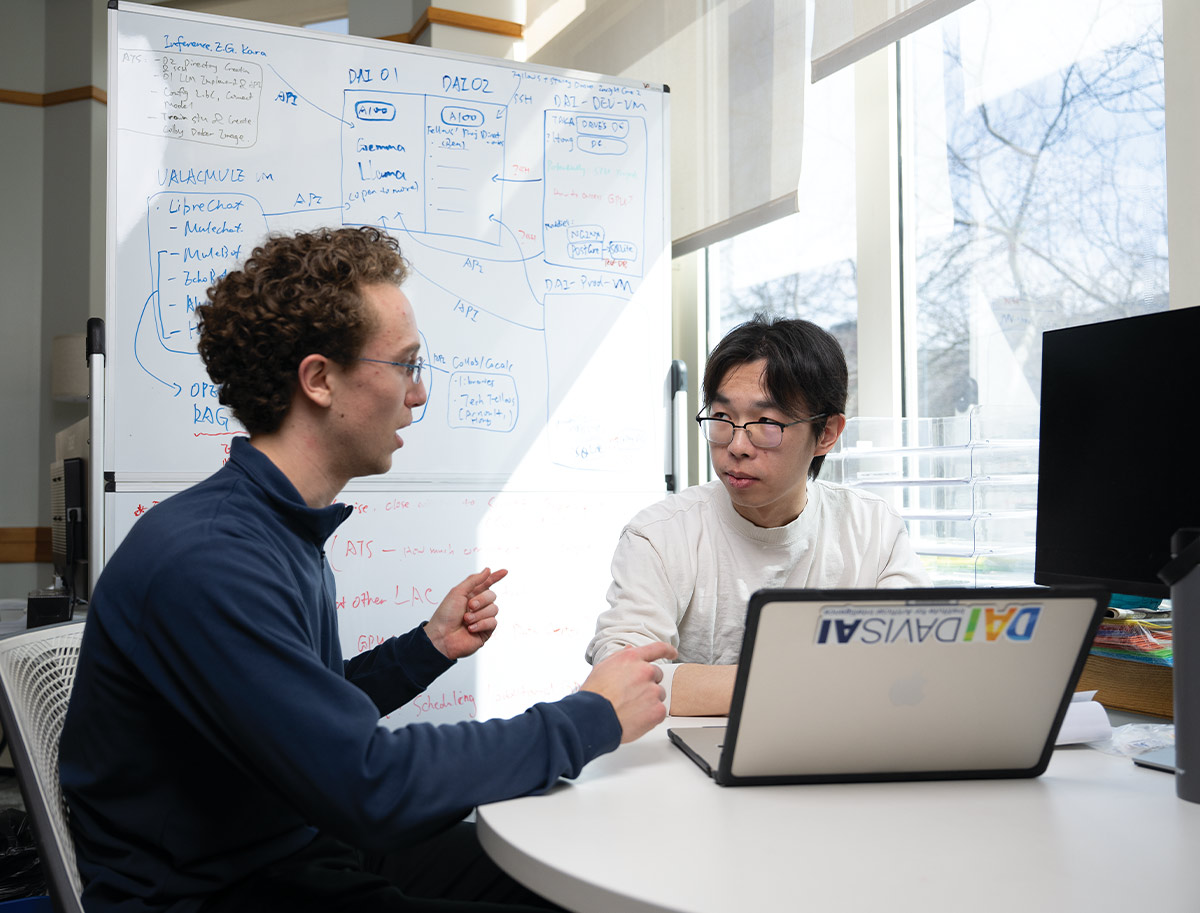
The range of work on campus
“He’s doing philosophy and dance, and then he’s considering how we bring AI into it, and what is it going to do to enhance what he’s doing? I told him he’s the poster child for Davis AI because that’s exactly what we’re trying to do,” he said.
Working with Baker, Sardor Nodirov ’26 found a home for his intellectual curiosity in Colby’s AI community. He was inspired to attend Colby specifically because of the Davis Institute’s mission. “When I was choosing colleges, I saw a promotional video of Davis AI being established on the Colby campus. It inspired me, just the mission behind it to create an AI institution on a liberal arts campus to empower the next generation of policymakers and informed citizens around AI,” said Nodirov, who grew up in Uzbekistan.
With Baker’s assistance, he is developing 3D reactive avatars to give AI a virtual embodiment. His project focuses on human-computer interaction, aiming to create virtual companions that use facial expressions and gestures to make digital interactions feel more genuine and empathetic.
“How can we model and improve the interactions between computers and humans?” Nodirov asked. “How can we make that interaction more genuine and natural? When you ask something sad, it is supposed to make a sad expression. When you crack a joke, hopefully it will smile and laugh—if it’s a good joke.”
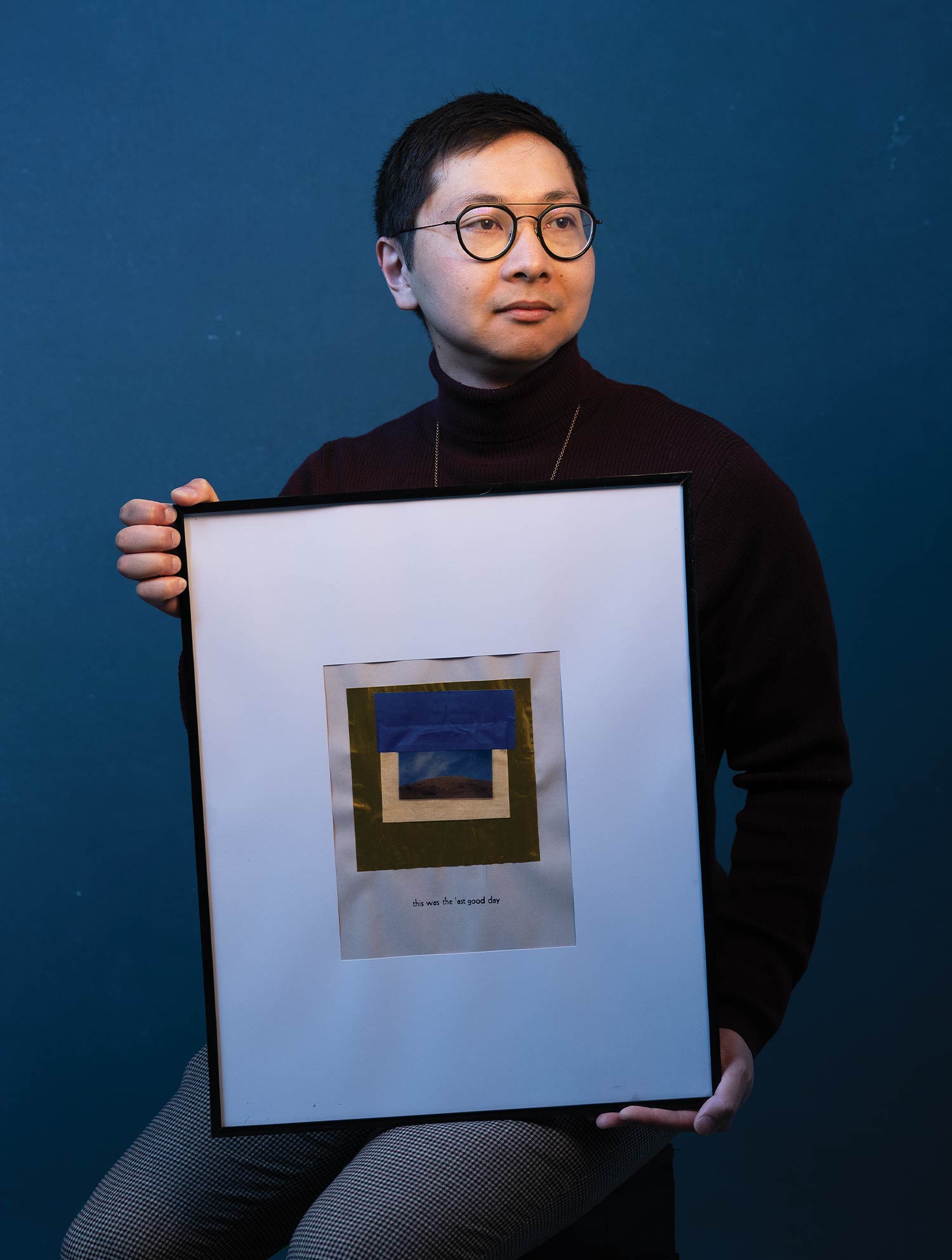
Associate Professor of Computer Science Stacy Doore and the students from her INSITE lab are using a multimodal generative AI model to create a museum curator tool to help make it easier to create accessible descriptions for artwork. She is partnering with the James M. Gillespie Professor of Art Véronique Plesch in this work that combines AI with human experts. In the arts, Assistant Professor of Art and current Davis AI fellow Taka Suzuki is using a sabbatical to generate a yearlong series of climate fiction stories and images through AI. Critically, Suzuki tracks the carbon offset of every prompt, raising awareness about the environmental resources required to fuel these models. His work will culminate in a gallery space where the public can interact with a custom chatbot trained on his synthetic climate future data.
Classroom integration of AI has flourished through the work of Tahiya Chowdhury, assistant professor of computer science, who has been involved with Davis AI from the beginning. She was the Davis Institute’s first postdoctoral research fellow after receiving her Ph.D. and a master’s in computer engineering from Rutgers University. She remained at Colby as a Davis AI-sponsored assistant professor working in computer science.
Chowdhury leads what is known as the HUMANE Lab—HUman, MAchiNe, and Environment—where student researchers engage in research to address how humans, machines, and the natural environment coexist. Her work mixes machine learning and human-computer interaction with a focus on human-centered tools and technology development for social good.
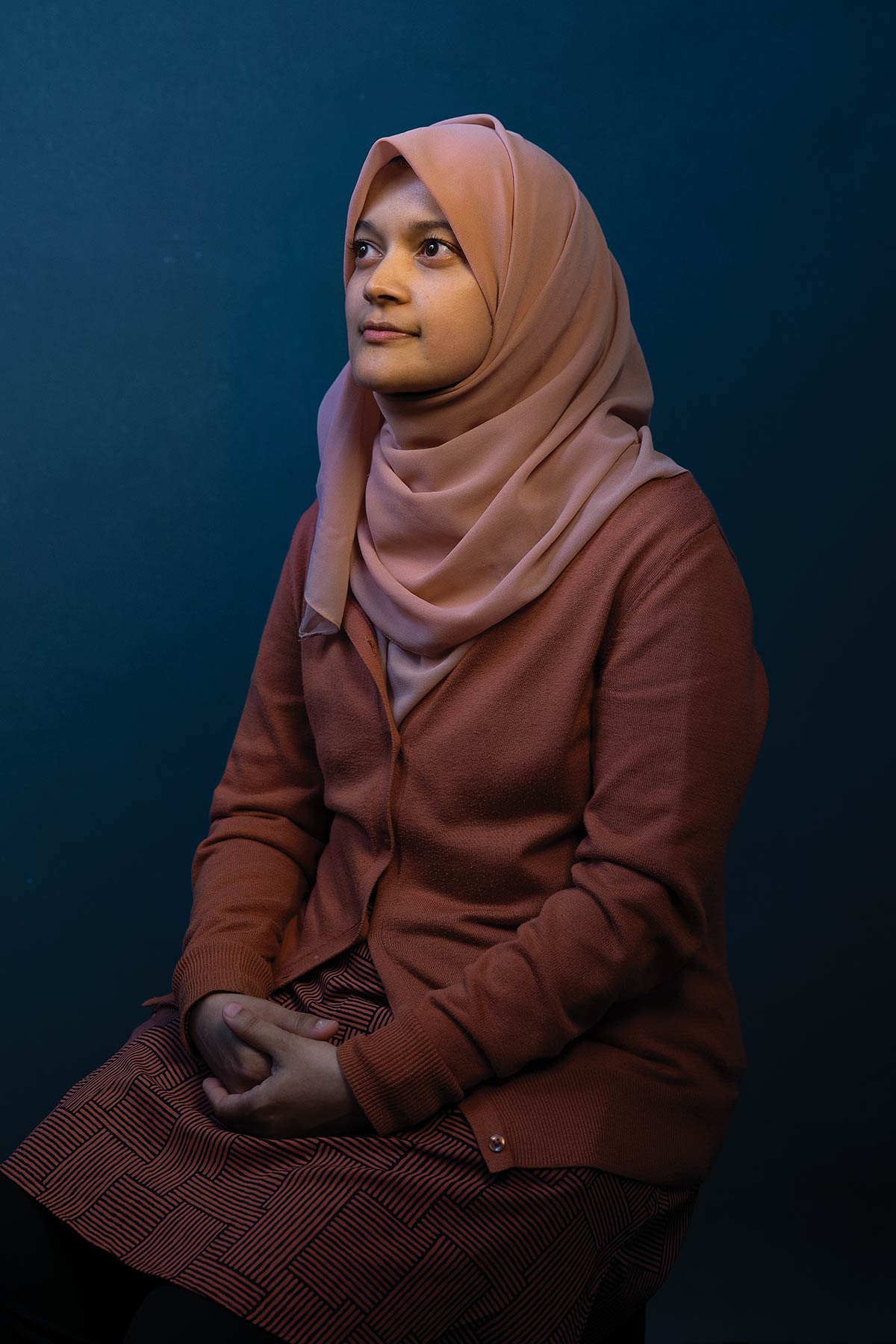
This spring, the second part of the course covered multimodal interaction and learning, where students expanded ideas and concepts they learned in the fall to sources beyond images, such as text and audio data.
The library as lab
On the other hand, the transcription project didn’t go as well. “We achieved about 80 percent accuracy, which would be successful in a non-academic environment, but being in an academic environment, there is some hesitation to push those out publicly because they are not 100 percent accurate, or not even 90 percent accurate,” LeVan said.
Data Services Librarian Kara Kugelmeyer, who joined the libraries after a robust career in the technology sector, works to help students and faculty critique and “make the black box of AI visible.” Her work involves educating the campus, and beyond, on the dangers of misinformation, disinformation, and the ethical implications of data management. She has presented on AI literacy in libraries at national conferences, elevating Colby’s stature in the AI field.
By partnering with Davis AI, the library ensures that students are prepared for a world where they must evaluate AI tools as both users and non-users, she said. “Libraries are well placed to help people work through every aspect of these types of projects, and in doing so, we are preparing students for their work outside of Colby,” she said.
Ethical concerns
Her skepticism is rooted in ethical concerns, ranging from data privacy and plagiarism to the environmental impact of large language models. She lacks trust in tech companies’ assurances that uploaded data won’t be used for training, comparing her level of confidence to “eating a piece of pizza picked up on the New York subway.”
Having previously served as the academic integrity coordinator, Coane is concerned that students have adopted generative AI broadly and without consideration of the ethical issues. More generally, she worries how generative AI is being used as a shortcut to writing, eliminating the struggles associated with the process of learning and making it what she calls “a frictionless experience, when what we know about the science of learning is that it is not frictionless.”
Ultimately, Coane’s goal for her fellowship was to better understand—and determine if she can trust—the underlying mechanisms and processes of AI to determine if computational tools can capture patterns in data that human coders might miss, without sacrificing accuracy or falling on the models’ inherent biases.
Watts understands the concerns and appreciates the skepticism. The challenges posed by these conversations are critical to the ethical evolution of AI that improves lives—the core mission of Davis AI.
And those difficult conversations are best suited for the collaborative, interdisciplinary environment of a liberal arts college that allows for nuanced conversations that are often impossible within the silos common at larger institutions.
“This kind of engagement allows new kinds of inquiry and new kinds of collaboration to emerge,” he said. “And it allows Colby to lead.”