
Whatever the Problem, Community is the Answer

Sherry Pineau Brown believes collaboration, not competition, can ease the crises in education
Story by Laura Meader
Photos by Ashley L. Conti and Gabe Souza
For years, Assistant Professor of East Asian Studies Andie Wang tried to place her students in multilingual classrooms for observations and practicums. She had to take her aspiring teacher candidates to Portland and Lewiston, where English- language learners abound in public school classrooms. But that wasn’t sustainable or practical.
“Then Sherry Brown came to Colby,” said Wang, eyebrows lifting. “She changed a lot.”
“She built this structure,” said Wang, fingertips pressing together to create a scaffolding. “I don’t need to go knock on doors or send out emails myself. There’s a structure there to attract people together for the same purpose.”
Through the consortium, Wang is now part of a group of teachers, librarians, and others interested in supporting multilingual learners.
“I’m glad we have this consortium. It makes my work a lot easier when I want to place students in classrooms, and I can continue to explore more ideas of how to work closely with the local community,” said Wang, whose department has a history of working with the Waterville community. “How to use Colby resources to support them, and how to bring them into my classroom to enrich my students’ learning experience.”
The Central Maine Education Consortium is designed to break down silos through a network that elevates the teaching profession and supports central Maine educators. The consortium will act as a nexus where educational practices, school and teacher needs, and research intersect and inform one another to find solutions specific to the needs of rural central Maine.
Because, as Brown likes to quote author and leadership coach Margaret J. Wheatley, “whatever the problem, community is the answer.”

Mimi Brick ’28, an educational studies major from New York City, has attended a few consortium events, including one where she met a representative of the Maine Department of Education. “It’s nice that I’ve already started making connections with people in the central Maine education realm,” she said.
A Purpose-Driven Initiative
Across the nation, education from preschool to higher ed is under attack, said Brown. Shrinking school budgets, declining K-12 student populations, Covid-related learning losses, behavioral and mental health issues, and teacher burnout are among the plethora of challenges facing America’s educational system. Central Maine is not immune to these challenges, of which Brown is well aware as a Waterville native with more than 20 years of experience teaching in the area. She brings a sense of urgency to her work.
“Our teachers are struggling,” said Brown, who knows that teachers often feel detached, alone, or unheard. And yet, central Maine is flush with resources, with three higher education institutions—Colby, Thomas College, and Kennebec Valley Community College—along with school districts and community organizations. Everyone is doing good work, but largely in isolation.
“The more we silo ourselves, the worse off we are,” she said. “We should all be working together.”
Now in its second year, the Central Maine Education Consortium is bringing people together in the spirit of collaboration rather than competition through professional learning networks. More than 150 people have participated in one of the consortium’s many events, workshops, or special interest groups.
“I’m working toward something positive,” she said. “The consortium is a way to really think about how we can all work together to create this really rich educational community for educators, students, and for the community in general.” Brown’s research focuses on teacher resilience and positive persistence. It’s in her nature to see the bigger picture.
“I’m a purpose-driven person.”
Finding a Partner in Thomas College
“When I say I know this community, I do. And I know the strength that we have in this community and in our teachers,” Brown said at last fall’s Dine & Discuss, the consortium’s biannual event for stakeholders. “It’s only through coming together that we’ll really be able to make central Maine thrive. And it’s because of folks like all of you,” she said, gesturing to the teachers, school administrators, librarians, state officials, and community partners who gathered at Thomas College for the event.
A year after Brown joined Colby’s faculty in 2023 and began initial work toward a consortium, she approached Katie Rybakova, associate director of education and chair of the Lunder School of Education at Thomas College.
The two educators shared a vision of bringing people together, and in 2024 they jointly founded the consortium, focusing on school districts in China, Fairfield, Oakland, Waterville, and Winslow.

Caitlin Kincaid (left), program coordinator for Colby’s Center for Small Town Jewish Life, participates in an event of the Central Maine Education Consortium.
Benefits of Community
Waterville High School ESOL (English for Speakers of Other Languages) teacher Avery Munns ’21 is the facilitator for the Multilingual Learner Support special interest group.
Originally from Topeka, Kan., Munns double majored in educational studies and sociology at Colby and taught in Alaska and at Lewiston High School in Maine before returning to Waterville last fall to teach ESOL.
Leading the Multilingual Learner Support SIG has been “really positive” for Munns as a newcomer to the area. His SIG includes a wide range of representation from area districts, adult education, libraries, and Colby—people he might not have met otherwise, or quickly.

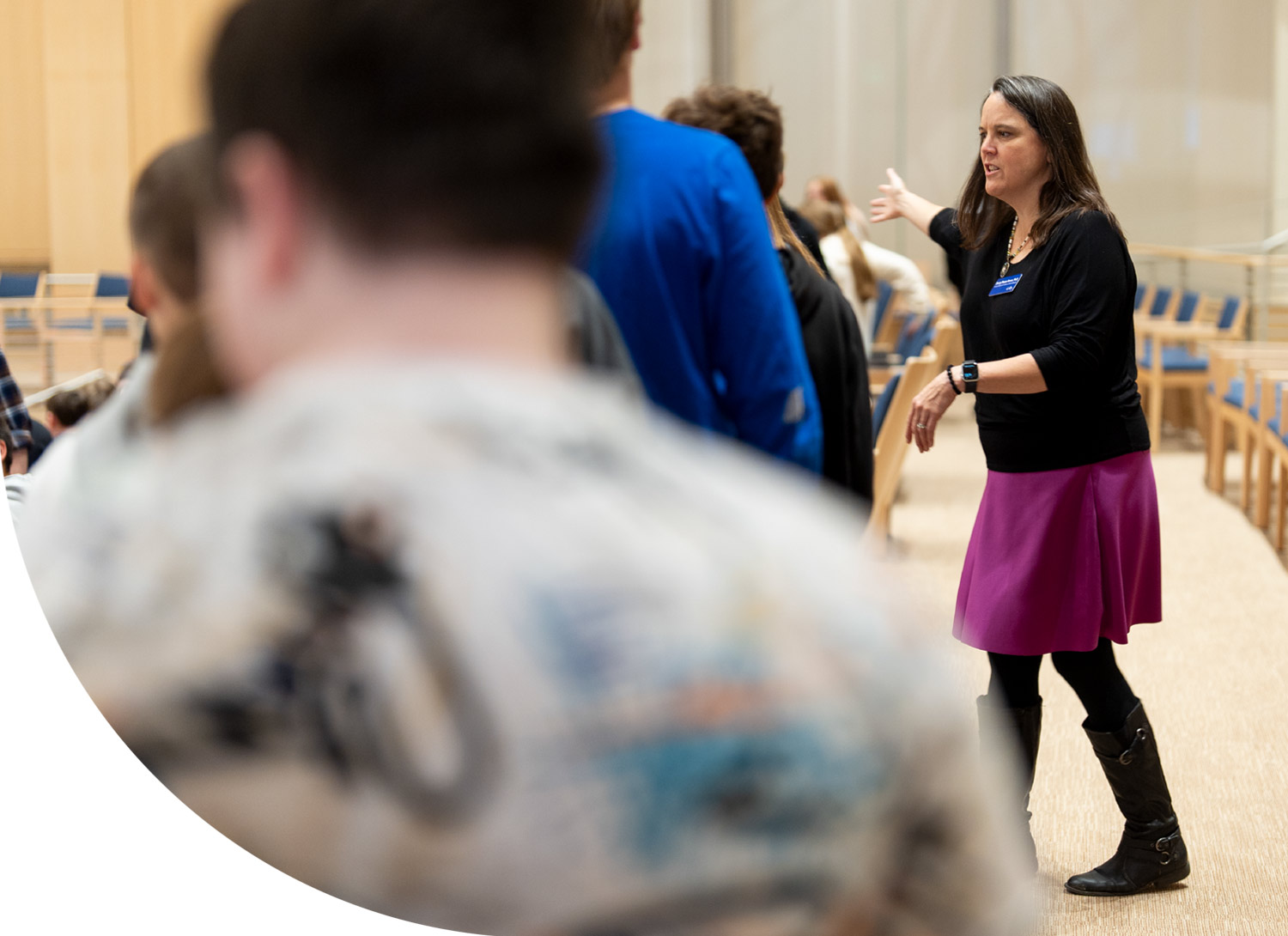
Assistant Professor of East Asian Studies Andie Wang talks with Avery Munns, an English for Speakers of Other Languages teacher in the Waterville public schools system. Through the Central Maine Education Consortium, Wang is part of a group of teachers, librarians, and others interested in supporting multilingual learners.
Engagement for Current Students
While the consortium was not in place when Munns was a student, it’s here for Mimi Brick ’28, an educational studies major from New York City. Brick has attended a few consortium events, including last fall’s Dine & Discuss, where she saw a representative from Maine’s Department of Education, whom she had met through an organized lunch on campus, and a principal from a school where she had observed.
“It’s nice that I’ve already started making connections with people in the central Maine education realm,” said Brick. At the Dine & Discuss roundtable breakouts, she joined the Outdoor Education SIG.
“It was really interesting to see how all these teachers are trying to integrate outdoor education into their classrooms and bring it to their schools,” said Brick, who loved seeing teachers from different schools sharing ideas, challenges, and solutions. She thinks the consortium is “a great idea.”
“Why wouldn’t we share ways to keep building … when there’s a whole network of us who are trying to do the same thing?”

Students from across the region participate in a poetry event organized by the Central Maine Education Consortium and Colby Arts.
Credibility and Intention
Other times, it’s two steps forward and one step back, Brown said. The breadth of challenges facing education can be overwhelming. So can navigating the town-gown relationship between Waterville and Colby. Her sensitivity to the situation allows her to bring intention and credibility to the table.
“Sherry has experience and context to back up her reputation. She’s lived it. She knows it all, and that breaks down a lot of barriers for people,” said Munns. “Sherry is trustworthy, and she doesn’t have to overcome some of the hurdles that an outsider may have to overcome.”
Town-gown tensions should always be addressed and navigated with care, added Tyler French, associate director of artistic planning and community engagement for Colby Arts. French is also the facilitator for the consortium’s Arts Education SIG.
“I think for me, the best part is being able to connect with people who understand what your job is like, what you’re going through, and the challenges you’re facing.”
“These things always move at the speed of trust, and if we keep demonstrating trust, we can move faster,” he said. “Not that speed should also be one of our goals. I think the goal is that we build a strong structure that works, and that will sustain.”
French has faith in the consortium because it employs a network theory. “It’s not just one person holding it; the strength of the network relies on these multiple kinds of connections that people have.”
Central to that network is Brown. “She’s always asking us to think bigger and to dream bigger,” French concluded. “She’s an incredible connector.”